
Tailgating — when an unauthorized person follows an authorized entrant through a door or turnstile — is a simple action with complex consequences. Facility and property managers who want to prevent tailgating in office building Toronto need pragmatic, site-specific strategies that combine hardware, software and people processes. This article outlines common scenarios, technical options and operational best practices that work in Toronto and the Greater Toronto Area.
Common scenarios in multi-tenant and single-tenant offices
Tailgating happens in predictable ways: a courier slips behind a tenant during a busy delivery window; an escorted guest is allowed to walk through without credential verification; shift changes create a steady flow of staff rushing through doors; or a held-open door invites opportunistic entry. Identifying these patterns at your property is the first step toward effective tailgating prevention Toronto managers can implement immediately.
Risks from tailgating
Unauthorized entry increases the chance of theft, workplace violence, and damage to tenant property. It can expose landlords to regulatory or lease compliance issues and harm a building’s reputation for safety. Addressing tailgating is not just about stopping theft — it’s about protecting occupants, assets and the building’s operating model.
Technical solutions overview
Security turnstiles and speed lanes
Security turnstiles and speed lanes are effective for lobby control where architecture and traffic flow allow. They provide a physical barrier that forces one-person-at-a-time passage and can be paired with credential readers to enforce entry policies. Consider full-height or waist-high models depending on the desired level of deterrence and lobby aesthetics.
Access control features that reduce tailgating
Modern access control systems include anti-passback, forced-door detection, door-held alarms and mantrap configurations. Anti-passback prevents a credential from being reused improperly; door-held alarms notify security when a door remains open beyond a safe interval. Mantraps — two-door vestibules where the first door must close before the second opens — are useful for high-security entries.
Biometric and hands-free readers
Biometric entry systems and hands-free readers help in high-traffic or high-security areas where credential sharing or tailgating risk is elevated. Biometric readers reduce dependency on transferable cards, while mobile and contactless options speed throughput while still verifying identity. Evaluate throughput, privacy considerations and tenant acceptance when selecting biometric solutions.
Intercom and visitor verification workflows
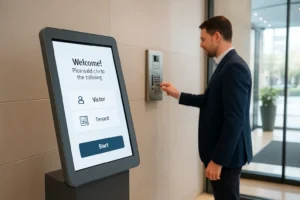
Intercoms integrated with controlled doors allow security or reception to verify and grant entry without physically opening doors. For escorted visitors, configure workflows in your visitor management system that require digital check-in, host approval and time-limited credentials to reduce visitor management tailgating.
Video analytics and camera placement
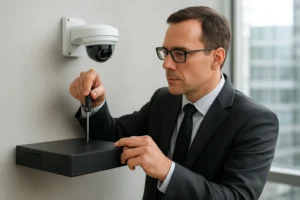
Integrating CCTV with access control events lets you detect and investigate tailgating. Video analytics can flag multiple people passing a reader in quick succession or track someone tailgating an entry point. Place cameras to cover readers, turnstiles and vestibules while ensuring clear sightlines for analytics to work reliably.
Operational and policy measures
- Staff and tenant training: Train front-of-house staff and tenants on not holding doors and reporting incidents; regular reminders reduce casual lapses.
- Sign-in and escort procedures: Use signed escort policies for visitors and contractors; clearly post expectations at entrances.
- Visitor management configuration: Issue time-bound credentials, require host approval and use badge-printing or mobile passes to limit opportunities for tailgating.
Design checklist for Toronto/GTA installations
- Assess lobby traffic and peak flows to choose between turnstiles, speed lanes or door controls.
- Choose hardware rated for local climate where exposed — vestibules, canopies and freeze-thaw cycles matter in the GTA.
- Plan network and cybersecurity for integrated systems: segment access control and CCTV on managed VLANs, and enforce strong authentication for management consoles.
- Establish maintenance and monitoring: schedule sensor tests, firmware updates and log reviews to keep systems reliable.
Vendor and procurement checklist
Ask integrators about installation approaches, warranty terms, service response time and on-site support options. Confirm experience integrating access control with intercoms, VMS/NVR platforms and identity systems (including M365 where relevant). Require proposals that describe phased deployment and testing plans rather than one-time installs.
Implementation roadmap
Start with a site survey to map vulnerabilities. Run a pilot or phased deployment in a high-traffic zone, collect operational data, deliver staff and tenant training, then audit the system and adjust settings. A phased approach minimizes disruption and lets you refine settings before building-wide roll-out.
Service benefits
- Reduced unauthorized access and improved occupant safety.
- Clear audit trails combining access logs and video evidence.
- Scalable solutions that fit single-tenant, multi-tenant and mixed-use properties across the GTA.
Why choose 360 IT Advanced Security
360 IT Advanced Security provides site surveys, security turnstiles and access control solutions, biometric entry systems, intercom workflows, VMS/CCTV integration, ongoing maintenance and network segmentation for Toronto commercial properties. We focus on practical installations and integration with existing building systems to reduce tailgating opportunities while preserving tenant experience.
To reduce tailgating and strengthen building security, contact 360 IT Advanced Security to schedule a site survey.
Conclusion: Preventing tailgating requires layered solutions — the right hardware, thoughtful policies and ongoing maintenance. Facility managers in Toronto and the GTA can reduce risk by combining turnstiles or controlled entries, access-control features, visitor workflows and trained staff with regular audits and integration best practices.